Shipping Container Dimensions: 20ft, 40ft and High Cube Sizes Explained
Posted in :

Shipping container dimensions are fixed on the outside and smaller on the inside, which is where most planning mistakes start.
Container sizes sound simple until you try to use them. A 20ft container is not 20 feet long inside. A 40ft is not twice the usable volume of a 20ft for every cargo. And the figure most listings lead with, the external length, is the one number that tells you least about whether your goods will fit.
Container dimensions are standardised under ISO, so a 20ft box from one manufacturer matches one from another to within millimetres. That consistency is useful. It means you can plan a load, a fit-out or a storage layout against published figures with confidence, provided you use the right figures.
This page sets out the full dimensions for every common size, explains which measurement governs which decision, and works through a pallet loading example you can apply to your own goods.
Full dimension tables
All figures below are the ISO standard dimensions for general purpose dry containers.
External dimensions
| Container | Length | Width | Height |
|---|---|---|---|
| 10ft | 3.048 m | 2.438 m | 2.591 m |
| 20ft standard | 6.096 m | 2.438 m | 2.591 m |
| 20ft high cube | 6.096 m | 2.438 m | 2.895 m |
| 40ft standard | 12.192 m | 2.438 m | 2.591 m |
| 40ft high cube | 12.192 m | 2.438 m | 2.895 m |
Internal dimensions
| Container | Length | Width | Height | Capacity |
|---|---|---|---|---|
| 10ft | 2.845 m | 2.330 m | 2.350 m | 15.89 m³ |
| 20ft standard | 5.944 m | 2.330 m | 2.350 m | 32.85 m³ |
| 20ft high cube | 5.944 m | 2.330 m | 2.650 m | 37.09 m³ |
| 40ft standard | 12.014 m | 2.330 m | 2.350 m | 66.83 m³ |
| 40ft high cube | 12.014 m | 2.330 m | 2.650 m | 75.32 m³ |
Door openings and tare weights
| Container | Door width | Door height | Tare weight |
|---|---|---|---|
| 10ft | 2.280 m | 2.260 m | 1,450 kg |
| 20ft standard | 2.280 m | 2.260 m | 2,230 kg |
| 20ft high cube | 2.280 m | 2.560 m | 2,230 kg |
| 40ft standard | 2.280 m | 2.260 m | 3,950 kg |
| 40ft high cube | 2.280 m | 2.560 m | 3,950 kg |
External versus internal, and why the gap exists
A 20ft container measures 6.096 m outside and 5.944 m inside. That is 152 mm lost. Width loses 108 mm, height loses 241 mm on a standard.
The difference is structure. Corrugated steel walls are profiled, so the corrugations eat into the width. The floor sits on cross members above the base frame, raising the internal floor level. The roof has its own frame. None of that is waste, it is what allows a loaded container to be stacked nine high on a ship, but it is space you do not get to use.
Use external dimensions for one thing only: working out whether the container fits on your site, through your gate and within your planning footprint. For every other decision, use the internal figure.
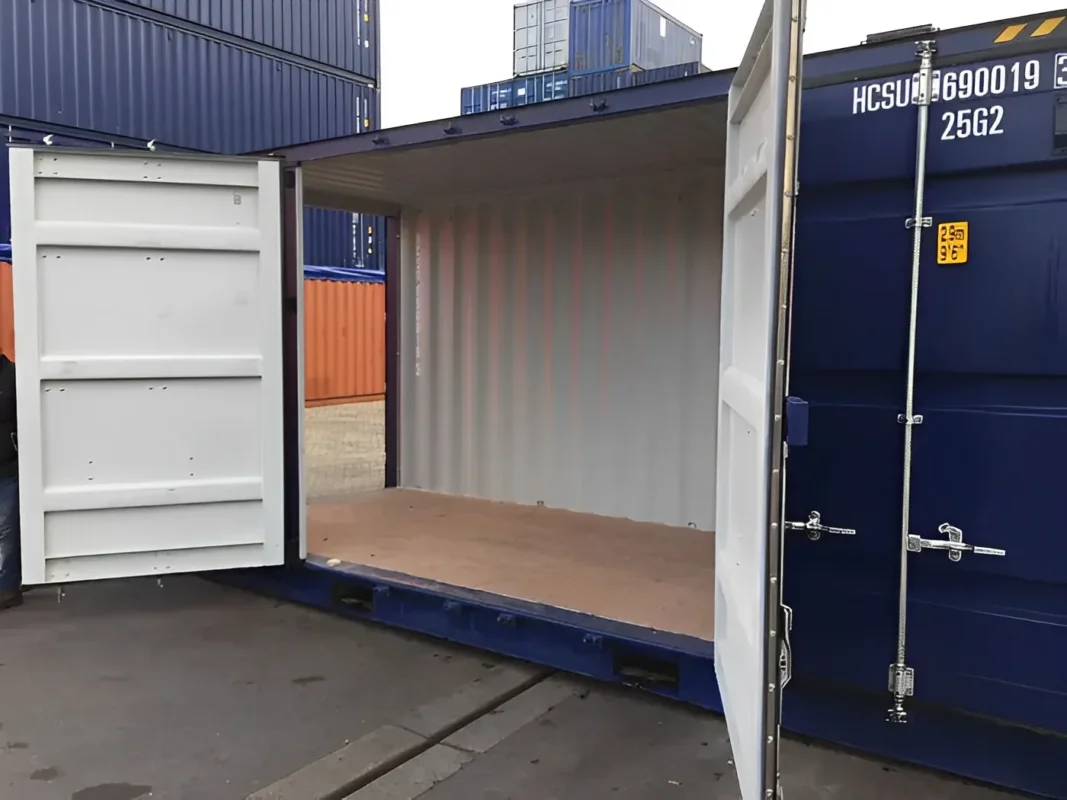
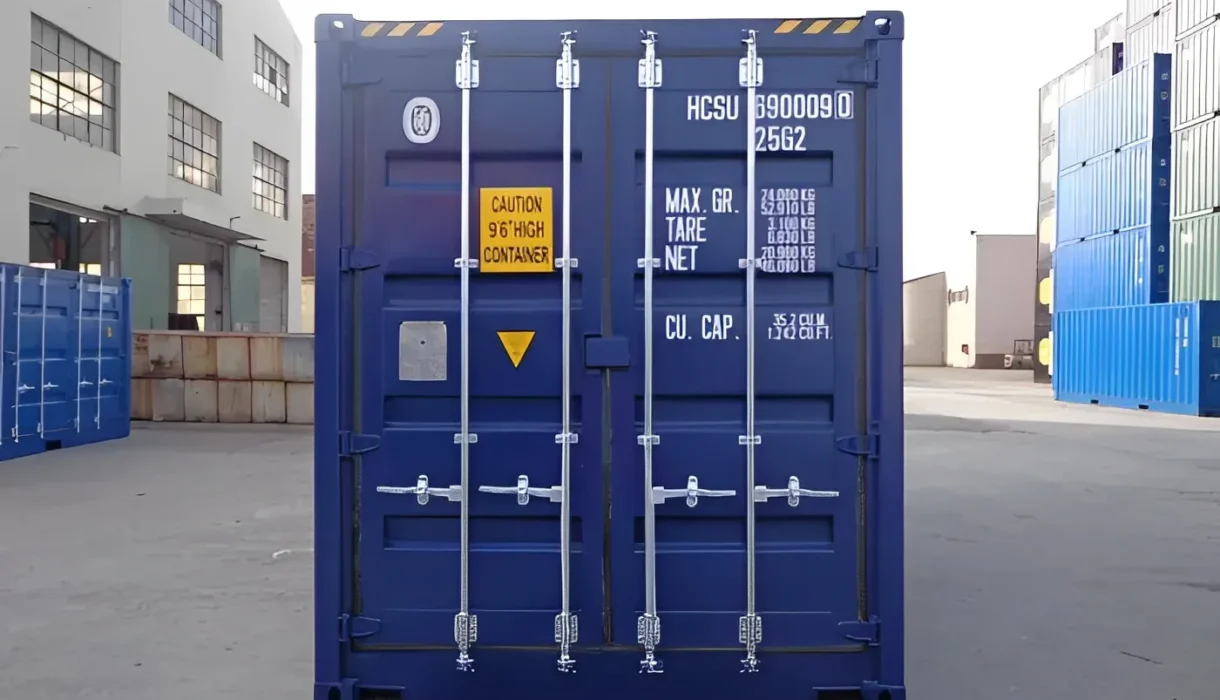
The door opening is the real constraint
This is where plans fail. The door opening is smaller than the internal cross section on every container. A standard 20ft has an internal height of 2.350 m but a door height of 2.260 m, and an internal width of 2.330 m against a door width of 2.280 m.
If the thing you are storing is 2.30 m tall, it fits inside the container and will not go through the door. The doors close against a steel header and sill, and those frames are fixed.
High cubes gain most of their extra height at the door: 2.560 m against 2.260 m on a standard. If you are moving tall machinery, plant, racking or vehicles, that 300 mm at the opening is usually the deciding factor rather than the 300 mm of internal height.
Measure your tallest and widest item, add clearance for the pallet or skids underneath, and check it against the door figure before anything else.
Remember that the item has to travel through the opening, not just match it. A forklift carrying a load needs the mast and the load backrest through the same doorway, and a pallet truck needs room to turn once inside. If a machine clears the opening by twenty millimetres on paper, it does not clear it in practice.
One more point on doors. Cargo doors need space to swing. A full pair opens through roughly 270 degrees and needs around 2.5 metres of clear ground in front of the container before the doors are flat against the sides. Sites that place containers tight against a wall or another unit lose that access entirely, which is a common reason buyers later pay for a personnel door.
Tare weight, payload and gross
Three weight figures matter. Tare is the empty container: 2,230 kg for a 20ft, 3,950 kg for a 40ft, 1,450 kg for a 10ft. Payload is what you put in. Gross is the two added together.
For static storage on your own land, tare matters for ground bearing and for the lifting equipment. For transport, gross weight is what road and shipping limits apply to, and it is easy to exceed the road limit long before you fill the space.
A useful check: a 20ft container holds 32.85 m³. If your goods average 400 kg per cubic metre, a full load is over 13 tonnes before the container’s own weight. Dense cargo fills a 20ft on weight, not volume. Light cargo fills a 40ft high cube on volume with weight to spare. Work out which limit you hit first, because it decides which size you actually need.
Worked example: pallet loading
A standard Euro pallet is 1.2 x 0.8 m. A UK or industrial pallet is 1.2 x 1.0 m. The internal width of every container here is 2.330 m, so the arithmetic is the same across sizes.
Euro pallets in a 20ft
Two Euro pallets side by side at 1.2 m wide each gives 2.4 m, which exceeds 2.330 m. They do not fit that way. Turned so the 0.8 m side runs across the container, you get two across at 1.6 m, leaving 730 mm spare. Along the 5.944 m length that arrangement gives four rows: 4 x 1.2 m = 4.8 m, with 1.14 m left over.
That is 8 pallets in a clean uniform load. Now use the 1.14 m of length left at the door end. Turn the pallets so the 1.2 m side runs across the container and the 0.8 m side runs along it. A 0.8 m deep row fits in the 1.14 m, but 1.2 m of pallet across a 2.330 m width leaves only 1.13 m, not enough for a second. So that last row takes one pallet, for 9 Euro pallets in a 20ft.
You will see 11 quoted for a 20ft. That figure assumes perfectly mixed orientation, pallets loaded to their exact footprint with no overhang, and no room left for strapping or dunnage. For planning a real load, work on 9 and treat 10 as the optimistic case.
Euro pallets in a 40ft
The 12.014 m length takes ten rows of 1.2 m with 14 mm to spare, two across at 0.8 m each. That is 20 Euro pallets in a 40ft, and the 14 mm of remaining length gives you nothing extra. Published figures of 23 or 24 rely on the same zero clearance assumption. Plan on 20.
Industrial pallets
At 1.2 x 1.0 m, two sit side by side across their 1.0 m dimension, using 2.0 m of the 2.330 m width. Along a 20ft, four rows of 1.2 m gives 4.8 m and a fifth row would need 6.0 m against an internal length of 5.944 m, so four rows is the limit. That is 8 pallets, plus one turned into the 1.14 m left at the door, giving 9 industrial pallets in a 20ft. A 40ft takes ten rows of two, so 20 industrial pallets.
Height is the second half of the calculation. A standard container gives 2.350 m of internal height. Deduct pallet height, typically 144 mm, and you have around 2.20 m of stacking height. A high cube gives you roughly 2.50 m. If your goods stack in 1.1 m units, the high cube takes two layers where the standard takes one plus wasted air.
Further reading
- ISO 668:2020, the standard that fixes container classification, dimensions and ratings (ISO)
- EPAL Euro pallet dimensions (European Pallet Association)
Choosing the size for your job
Run the check in this order. Door opening against your largest item. Internal footprint against your layout. Internal height against your stack. Weight against your denser goods. External dimensions against your site.
If the container is being converted rather than loaded, the high cube is almost always the right call. Insulation, ceiling battens and flooring take 100 to 150 mm out of the internal height, and 2.350 m becomes an uncomfortable 2.20 m ceiling. Starting at 2.650 m leaves you with a room people want to stand in.
You can compare sizes across the standard container range and the office container range, or tell us the dimensions of what you need to store and we will confirm which size takes it.
Shipping container dimensions at a glance
External sizes follow ISO 668, so a 20ft measures 6.06 m by 2.44 m by 2.59 m and a 40ft doubles the length only. Internal width never changes, and a lining takes 50 to 100 mm off each surface. Plan from the internal figures, not from the name on the box.