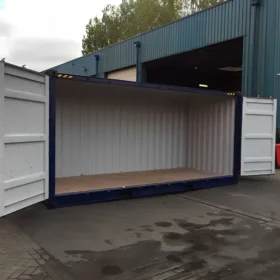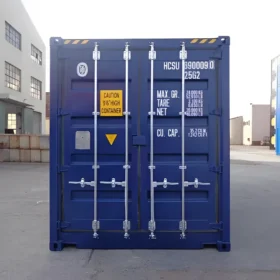


How are shipping containers delivered? Most arrive on a tilt bed lorry that slides the unit off on chains, which needs level load bearing ground and a straight clear approach.
Most container deliveries take less than half an hour on site. The lorry arrives, the driver positions it, the bed tilts, the container slides off on chains, and the vehicle pulls away. When it goes wrong, it goes wrong in the first two minutes, usually before the driver has even reached your gate.
Buyers spend a lot of time comparing container prices and almost none understanding the vehicle that brings it. That is backwards. The vehicle decides where the container can physically go, what your site needs to offer, and whether the delivery happens at all on the day you booked it.
This guide walks through the delivery itself: what gets booked, what turns up, what happens during the offload, and what a failed attempt costs you.
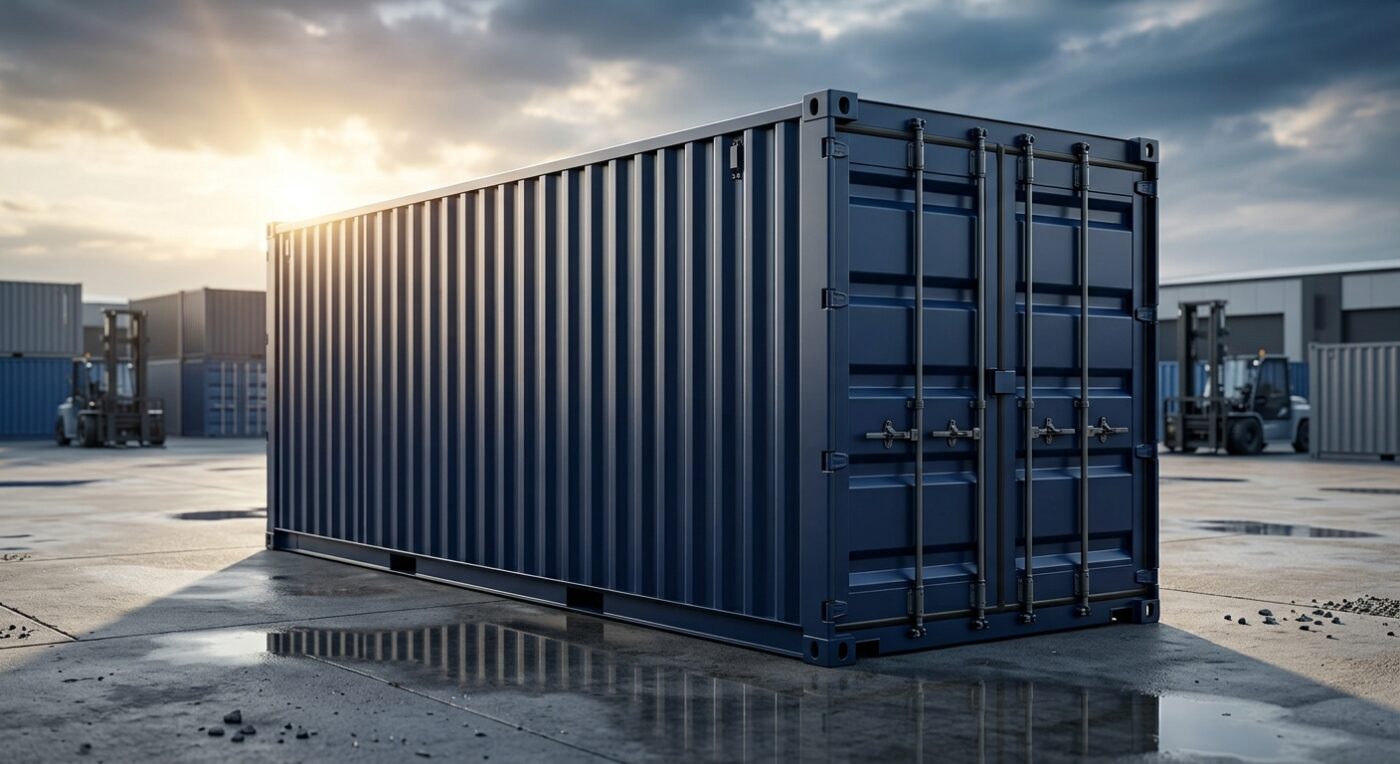
What happens between order and delivery day
Once a container is bought, the supplier books a haulier to collect it from the depot holding it. That depot is rarely the supplier’s own yard. Containers sit at inland terminals and port depots across Europe, and the one allocated to you is usually the nearest suitable unit, which is why delivery pricing moves with distance.
Before the booking is confirmed, you should expect questions about your site. A competent supplier asks how the lorry approaches, what the surface is, whether anything hangs over the route, and where exactly the container should stand. Answer those carefully. Every failed delivery in the industry traces back to an answer given optimistically.
You will normally get a delivery window rather than a time. Hauliers run multiple drops a day and traffic decides the rest. Expect a morning or afternoon slot, and expect a call from the driver when he is close.
What you need to have ready
- Someone on site who can make decisions and sign for the container.
- The placement marked out physically, with paint, pegs or timber, not described verbally.
- The approach clear of parked vehicles, skips, pallets and plant. A car parked on the run-up line is the single most common avoidable failure.
- Gates unlocked and anyone who controls access available, including site security on commercial premises.
The vehicles, and what each one needs from you
Three vehicle types handle the vast majority of container deliveries in Europe. They are not interchangeable, and the one you get changes what your site has to provide.
Tilt bed or roll-off truck
This is the standard method and the cheapest. The bed hydraulically tilts backwards, the rear of the container touches the ground, and the container is winched down on chains as the lorry creeps forward. The box ends up on the ground exactly where the lorry was pointing.
The cost of that simplicity is space. The vehicle needs a clear straight approach of roughly 18 metres for a 20ft container and roughly 30 metres for a 40ft, measured in a straight line to the final position. It also needs around 3.6 metres of width and 4.2 metres of overhead clearance along the whole route, plus room to turn: allow roughly 18 metres of turning circle for a 20ft delivery and 24 metres for a 40ft.
Those figures are not negotiable on the day. The lorry either fits or it does not.
Flatbed with crane or HIAB
A flatbed carries the container and a mounted crane lifts it off and places it. This is the answer when the run-up does not exist: tight urban yards, positions behind a building, containers going onto a concrete plinth, or two boxes stacked.
Crane delivery places a container precisely, within centimetres, and needs far less straight approach. It costs more, sometimes substantially more, and it brings its own requirement: overhead clearance above the container’s final position, not just above the lorry. A crane has to lift the box higher than its destination and swing it across. Power lines, mature trees and building overhangs that a tilt bed would have driven under become hard stops.
The crane also needs firm ground for its outriggers, which concentrate very high loads into four small footprints.
Low loader
A low loader carries the container on a dropped deck and is used mainly for long distance haulage, abnormal loads, or where height restrictions on the route rule out a tilt bed. It does not unload itself. Something on site has to lift the container off, usually a forklift with sufficient capacity or a hired crane. If a low loader is quoted, confirm in writing who is providing the lifting equipment.

The offload, minute by minute
Once the lorry is lined up, a tilt bed offload takes 15 to 30 minutes. It goes roughly like this.
The driver assesses the final approach and the ground, then reverses or drives into position. He checks overhead clearance for the tilting bed, which rises well above travelling height. He deploys the chains, releases the twist locks holding the container to the bed, and begins to tilt.
The rear of the container touches down. The driver then drives slowly forward while the winch pays out chain, and the container walks off the bed onto the ground. He unhooks, lowers the bed, checks the position, and hands over paperwork.
The important point is what the driver cannot do. He cannot get out and manually nudge a two to four tonne steel box a metre to the left because you have changed your mind. Where the lorry points is where the container lands. Once it is down, repositioning needs a forklift or a crane, and that is a separate job with a separate cost. It is not part of a standard delivery.
Who does what
The driver is responsible for the vehicle, the offload and the safety of the operation. You are responsible for the site: access, surface, clearance and the suitability of the final position. If the driver judges the ground or the approach unsafe, he will refuse, and that judgement stands. Drivers refuse deliveries because they have seen lorries sink to the axles, not because they are being difficult.
Keep everyone else well back. There is no safe standing position beside a container coming off a tilt bed.
Why deliveries fail, in order
Failures cluster around four causes, and they repeat constantly across the trade.
- Not enough straight length. The most common by far. A site that measured fine around a corner does not work, because the 30 metres has to be straight.
- Overhead obstructions. Power and telecoms lines, low branches, gate headers, canopies and signage. People look at ground level and forget that a tilting bed goes up.
- Soft ground. The surface has to carry a loaded articulated lorry, not just the container. Concrete, asphalt, compacted hardcore, well-drained gravel and firm packed earth are fine. Waterlogged ground, fresh uncompacted gravel, slopes beyond a few degrees, and anything over septic tanks, drains or buried services are not.
- A blocked approach. Parked cars, a delivery van, stacked pallets, a skip that arrived yesterday.
A failed delivery means a wasted journey. You pay for it, typically the full delivery charge or a substantial share of it, and you pay again for the redelivery. On a long haul that can run into several hundred euros for nothing. Nobody wins, which is why suppliers ask the access questions before they book.
If you want the detail on getting the surface and the standing position right, read our guide on preparing your site for a shipping container delivery.

Plan the doors before the container arrives
Container doors need clear swing space in front of them, and you need to be able to reach them with whatever you are moving in and out — a pallet truck, a barrow, a forklift, your arms full of something heavy.
Decide which way the doors face before delivery, not after. Rotating a positioned container is a job; deciding on orientation beforehand is a sentence in an email.
Check the paperwork side
Depending on where the container is going, there may be permissions to sort: landlord consent, site induction requirements for the delivery driver, a permit for the location, or simply telling the right person on site that it is coming.
Work out who needs to know and tell them early. It is the cheapest part of the whole process and the easiest to forget.
A short checklist
- Route walked, width and height obstructions noted, photos taken
- Turning and offload space identified and kept clear on the day
- Ground level, firm and not in a puddle
- Door orientation decided
- Access restrictions and site hours confirmed
- Someone on site who can take the delivery
- Permissions and notifications handled
Run through that and delivery day becomes uneventful, which is exactly what you want it to be.
We coordinate delivery as part of the order, so raise anything tight or unusual when you send your requirements — that is the moment it is easiest to plan around.
Further reading
- Container safety and the CSC regime (IMO)
- ISO 668:2020, the standard that fixes container classification, dimensions and ratings (ISO)
Getting the delivery booked correctly
Describe your site honestly before anything is booked. Measure the straight approach with a tape, not by eye. Walk the route looking upwards. Stand where the container will go and ask whether a lorry could have pointed at that spot.
If the answer is no, say so early. A crane delivery quoted in advance is an ordinary cost. A crane arranged after a tilt bed has turned around in your gateway is an expensive one.
You can browse available units across the standard container range, or send us your site details and we will tell you which delivery method your access allows before you commit to anything.
How are shipping containers delivered, step by step
The lorry needs a straight run, firm level ground and clearance overhead. Clear the drop zone, confirm the gate widths, and decide which way the doors face before the vehicle arrives. Send us the site details and we will confirm the right vehicle.