Shipping container foundation guide: what your container actually needs
Posted in :

Ask three contractors whether you need a shipping container foundation and you will get three answers. We supply new, used and modified containers across Europe, and the honest reply depends on three things: the ground, how long the container stays, and what goes inside. This guide covers the principles, so you can work out what your site needs before anyone quotes for groundwork.
Does every container need a foundation?
Almost always yes. A container needs four firm, level bearing points, and the form that takes depends on your ground and your plans.
A container is happiest on ground that is firm, drains and stays level. Very few plots of bare European ground manage all three on their own for years at a time.
What changes is the scale of the work. A 20ft store on existing hardstanding for one winter may need nothing more than four levelled bearing points. The same box used as a workshop on soft clay for ten years is a different job. The real question is how much support the weakest part of the site needs.
Why does a container carry its whole weight on four corners?
All of the load runs through the four corner castings, so the ground has to carry a very high pressure over a very small area.
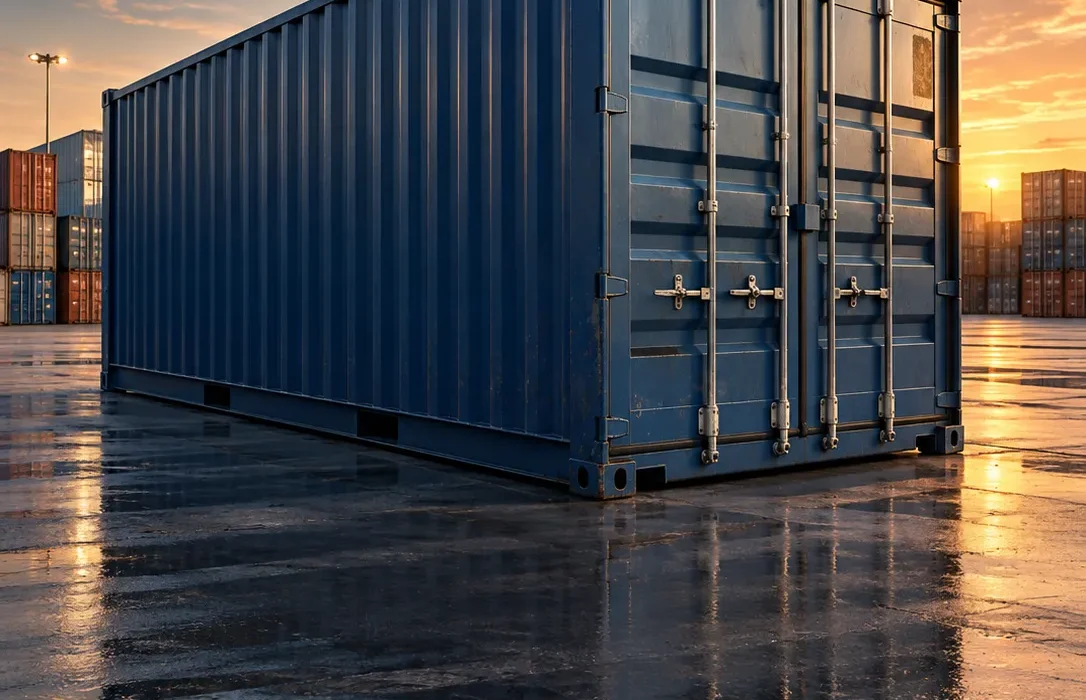
Under any container sit eight corner fittings specified in ISO 1161. The four at the bottom are the only parts designed to touch the ground, and floor, walls, roof and contents hang off the frame between them.
Each bearing face measures roughly 178 by 162 mm. A loaded 20ft can reach a maximum gross of 30,480 kg, which puts around 2.5 N/mm² on each pad. Even empty, a 20ft weighs about 2,200 kg and a 40ft about 3,800 kg, all landing on four small squares, not the full footprint.
What three questions decide the foundation?
Ground type, how long the container stays, and what you put inside it. Answer those three honestly and the right choice follows.
- What is the ground made of? Subsoil, hardcore, tarmac and made ground behave differently under a point load.
- How long does it stay? Time turns small settlement into a big one.
- What goes inside? Racked stock, machinery or an occupied space raises both the load and your tolerance for movement.
The footprint follows ISO 668: a 20ft is 6.06 m by 2.44 m, a 40ft is 12.19 m by 2.44 m. Our guide to container dimensions covers the rest.
How does your soil type change the answer?
Soil decides how much load the ground takes and how it moves through the year. Made ground and peat are the two that catch people out.
| Ground type | How it behaves | What it means for you |
|---|---|---|
| Made ground (fill, rubble) | Unpredictable, settles unevenly | Investigate before designing anything |
| Clay | Shrinks and swells with moisture | Seasonal movement, keep water away |
| Sand and gravel | Good bearing, drains well, washes out at edges | Usually the easiest ground to work with |
| Peat and organic soils | Very low bearing capacity | Almost always needs engineered support |
| Rock or solid hardstanding | Excellent bearing, no real settlement | Levelling and drainage are the jobs left |
If you cannot tell what you have, dig a trial hole at two corners. What comes out tells you more than the surface.
Does frost heave affect a shipping container foundation?
It can. Frost depth varies widely across Europe, so check your national annex and local authority before you commit to a design.
Frost heave happens when water in the ground freezes, expands and lifts whatever sits above it. It never lifts evenly, which is the problem for a rigid steel box. A bearing point founded above the frost line rises in winter and drops in spring.
Across Europe, frost depth commonly runs between 0.6 and 1.2 m depending on country and region, so there is no single number to quote. Rules are set nationally through the national annexes to the Eurocodes, and municipalities add their own. Ask your building authority before anyone digs.
How level does the ground have to be, and what happens if it is not?
Level within roughly 10 to 25 mm across the unit. Past that, doors bind, the frame twists and water stops running off the roof.
A container is a rigid welded frame, so level matters more than mass. It will not flex to suit your ground, so the ground has to suit it.
Doors are the early warning. They hang on a square frame, so once it goes out of square the locking bars stop lining up and the seals stop sealing. Sustained twist then racks the frame into a parallelogram, and that does not come back when you relevel.
On slope, a working rule: a fall up to about 50 mm across the footprint is correctable at the bearing points, 50 to 150 mm means building the low side up, and beyond that you are cutting or stepping the site. Our notes on preparing a site for delivery cover access too.
How do you choose a shipping container foundation for your site?
Walk the site, identify the ground, set the lifespan and the load, then match the support to the weakest of those three.
- Identify the ground. Dig, look, and ask what the site was before. Former yards and filled ponds hide problems.
- Set the lifespan. Permanent raises the bar on frost and settlement.
- Set the load. Empty storage, heavy racking, or an occupied space with services.
- Check slope and drainage. Water turns adequate ground into poor ground.
- Take the strictest answer. Good soil does not save an occupied unit from needing a design.
Bring in a groundworker once the job is understood but beyond a wheelbarrow: excavation, compaction, drainage and levelling to tolerance. Bring in an engineer when the ground is uncertain, when you are stacking, when the unit becomes an occupied building, or when the authority asks for a calculation. Half a day of advice costs far less than lifting a settled container to rebuild under it. Delivery shapes the design too, so read how containers are delivered.
What else do people ask about container foundations?
Short answers below on tarmac, on timber sleepers, and on whether a used container needs any less support than a new one.
Can I put a container straight onto tarmac?
Sometimes, for short periods and light loads. Tarmac spreads load poorly and softens in summer heat, so castings press in and leave dents. Spreader plates help.
Are timber sleepers good enough?
They work for temporary storage on firm, well drained ground. Timber rots, sinks into soft soil and moves seasonally, so we would not specify it for an occupied unit.
Does a used container need less support than a new one?
No. Used and new share the same frame, castings and tolerances, so the shipping container foundation is identical. Age affects paint and panels, not how load reaches the ground.
Last updated: September 2026
Tell us where the container is going, what the ground is like and what you will keep inside, and we will tell you what we would do. Browse our containers and ask us for a quote.