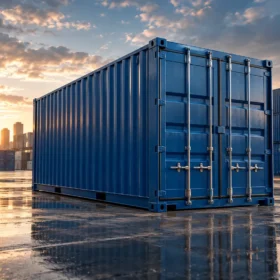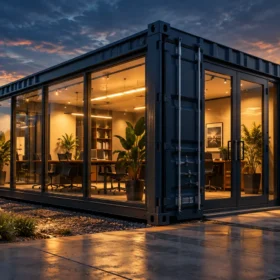


Your shipping container foundation cost is set by your ground, your access and how much material leaves the site, far more than by the container itself. We supply containers, we do not price groundworks, so every figure below is a typical 2026 European market range from groundwork contractors, not our price list. All ranges vary by ground conditions, access, region and contractor, and VAT treatment differs by country.
How much does a shipping container foundation cost in 2026?
Most container foundations in Europe cost between 150 and 6,500 euros in 2026, depending on the build type, the ground and the site access.
| Foundation type | Typical 2026 European range |
| Railway sleepers on prepared ground | 150 to 450 euros |
| Four concrete pads or heavy paving slabs under the corners | 300 to 900 euros installed |
| Compacted gravel pad, 20ft | 400 to 1,200 euros |
| Compacted gravel pad, 40ft | 700 to 2,000 euros |
| Concrete piers taken below the local frost line | 600 to 1,800 euros |
| Full reinforced slab, 20ft | 1,500 to 3,500 euros |
| Full reinforced slab, 40ft | 2,800 to 6,500 euros |
Two add ons sit outside the table. Excavation and muck away on soft ground adds 300 to 1,500 euros, and a groundworker costs 250 to 500 euros per person per day. If you are still sizing the unit, see our guide to what a shipping container costs in 2026.
What drives the price up or down?
Access for machines, the volume of soil removed, ground conditions, distance to a hard road, travel time and the season set the final price.
- Access for a mixer or a digger. Where a lorry mixer and a three tonne digger reach the spot, the job is often one day. Through a narrow gate by wheelbarrow the labour roughly doubles.
- Excavation and muck away. Digging is cheap, carting spoil off site is not. Tipping plus haulage turns a 600 euro pad into a 1,500 euro one.
- Ground conditions. Made ground, soft clay, peat or a high water table mean a deeper dig, more stone, or piers.
- Distance to the nearest hard road. Long barrow runs, or a temporary track for the tipper, add cost.
- Whether a groundworker travels. Travel, plant transport and a minimum charge can add 150 to 400 euros before anyone digs.
- The season. Winter work in wet clay is slower and the spoil is heavier, so quotes run above a dry August.
Our notes on preparing a site for container delivery list the access measurements a contractor will ask for.
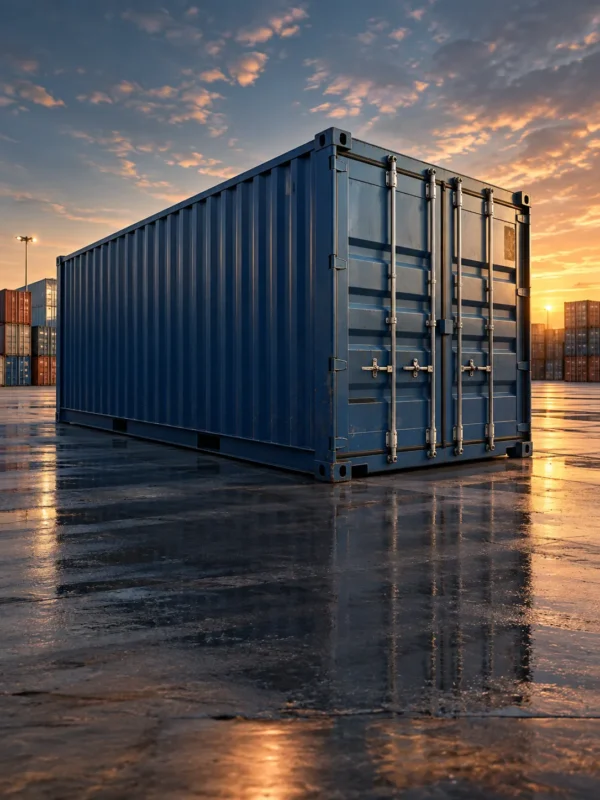
How do labour and materials split on a container base?
On most container bases labour and plant take roughly 60 to 70 percent of the bill, and materials take the remaining 30 to 40 percent.
That is why two quotes for the same pad differ by 500 euros. Stone and cement are priced within a few percent of each other, and days on site are not. Reducing the dig saves more than hunting cheaper aggregate.
What does a DIY gravel pad cost in materials?
Materials for a DIY gravel pad under a 20ft run about 150 to 400 euros, plus 60 to 120 euros a day for plate compactor hire.
That covers geotextile, crushed stone and edge restraint, assuming a tipper gets close and the stripped topsoil stays on site. DIY rarely fails on the shopping list:
- Stone tipped in one lift. Compaction works in layers of 75 to 100 mm, so a single 250 mm dump settles within a winter.
- No geotextile. Without separation, stone migrates into soft subsoil and the pad disappears.
- Topsoil left in place. Organic material rots and compresses, so it comes out first.
What is usually excluded from a foundation quote?
Spoil removal, drainage, reinstatement of damaged surfaces and extra stone once the dig opens up are commonly priced as separate items.
- Spoil removal. Often a provisional sum, or left out on the assumption that soil stays on site.
- Drainage. A land drain, soakaway or cut off channel is separate work.
- Reinstatement. Ruts in a lawn or a damaged drive are yours unless the quote says otherwise.
How do you compare two foundation quotes fairly?
Put both quotes on the same scope, then compare pad size, stone depth, spoil disposal, day rates and what happens if the ground is worse.
- Finished pad dimensions and the overhang beyond the container footprint.
- Excavation depth, compacted stone thickness and whether geotextile is included.
- Cubic metres of spoil assumed, and whether disposal is in the price.
- Day rate per person, days on site and plant hire, shown separately.
- The rate that applies if the dig goes deeper than assumed.
A container carries its weight through the eight corner fittings described in ISO 1161, so the bearing under those points is what your shipping container foundation cost buys.
When does spending more on a base save money?
Spending more pays off when the container is permanent, insulated, converted or heavily loaded, because fixing a base that has moved costs far more.
Lifting a loaded 40ft unit, stripping a failed pad and rebuilding it costs more than the original gap between a gravel pad and a slab. Over a 15 year life the cheaper base is the false economy for anything with a fitted floor, racking or heating.
For a plain dry store that may move in five years, sleepers or four pads are enough. A 40ft roughly doubles the prepared area, so our comparison of 20ft and 40ft containers is worth a look. Where a structure is designed rather than simply placed, contractors work to the Eurocodes, and that design input is a separate fee.
What does a worked container foundation budget look like?
A 20ft on a firm existing yard lands at 400 to 800 euros, while a 40ft on soft ground with a full dig runs 1,800 to 3,200 euros.
Example one, a 20ft on a firm existing yard. Four concrete pads under the corner positions, minor levelling, one day for two people. Total 400 to 800 euros, no spoil leaving site.
Example two, a 40ft on soft ground. Strip and excavate, geotextile, 250 mm of compacted stone in layers, levelling and edge restraint. Two to three days with a digger and dumper, spoil carted away. Total 1,800 to 3,200 euros.
What else do buyers ask about shipping container foundation cost?
Short answers on VAT, on whether a base is always needed, and on how long a correctly built gravel pad should last on a normal site.
Is VAT included in these figures?
No. These are net ranges, and VAT treatment of groundworks differs by country.
Do I always need a foundation?
A container needs level, stable bearing under the four corners. On a sound concrete yard, packing and levelling may be enough. On soil or grass, you need a prepared base.
How long should a properly built base last?
A well compacted gravel pad with geotextile and drainage commonly serves 15 years. A slab lasts longer and costs more up front.
Send us your site details and the container size and we will quote the unit and the delivery, so your groundwork budget sits around a firm number. See our containers and request a quote.