
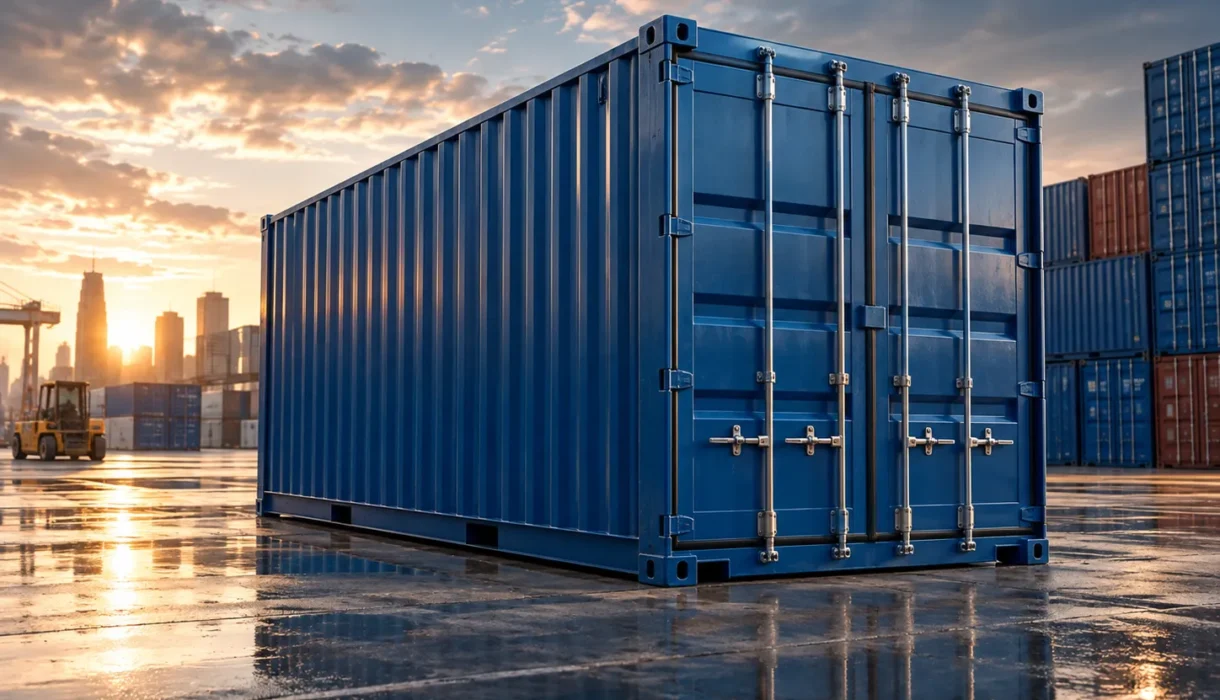

People ask us every week whether they can skip the groundworks and put a shipping container on dirt. Yes, you can, and plenty of owners across Europe do. Here is what that shortcut costs, so you can price it before the doors stop closing.
Can you put a shipping container on dirt?
Yes, and people do it every day. The unit will still work, but it will settle, sit off level and hold damp underneath the floor.
A container does not rest on its whole base. It puts its entire load through four corner castings, the fittings specified in ISO 1161, each roughly 178 by 162 mm. Four contact patches of that size concentrate the load heavily, even though the box looks like it spreads its weight along the rails.
An empty 20ft weighs about 2,200 kg and an empty 40ft about 3,800 kg. A loaded 20ft can reach a maximum gross of 30,480 kg. Put that through four small steel pads and soft ground has no chance of carrying it evenly.
What happens in the first year on bare ground?
One or two corners sink first, the doors begin to bind, and rainwater starts tracking under the unit instead of running past it.
- Weeks one to twelve: the heaviest corners bed into the soil. Nothing looks wrong yet.
- First wet season: doors stiffen. Binding starts at roughly 10 to 25 mm out of level across the door end, as the frame racks.
- End of year one: the container has made its own dip, so surface water runs to the low corners and sits under the floor.

Why does the underside rot before the walls?
The floor bearers sit low and close to the ground. Once airflow under the container stops, the steel there stays wet and corrodes first.
The floor deck sits on steel cross members roughly 100 to 150 mm above the bottom rail, and that void is what keeps the bearers dry. Air moves through it and water evaporates between rain events. Bed the unit into soil and that gap becomes a damp trap.
This also cancels the steel’s main defence. Corten weathering steel forms a protective patina in open air, but that needs the surface to dry between wettings, which is exactly what ground contact prevents. The walls will outlast the underside by years. For more on lifespan, see our guide on how long storage containers last.
Does soil type change the answer?
Hugely. The same container can be stable for a decade on compacted hardcore and visibly out of level within one winter on soft clay.
| Ground | Behaviour under point loads | Our view |
|---|---|---|
| Rock, compacted hardcore | Minimal movement, drains well | Best case, pads are usually enough |
| Compacted gravel | Small, even bedding in | Good, relevel once after year one |
| Sand, firm subsoil | Settles early, then stabilises | Workable with load spreading points |
| Clay | Soft in winter, shrinks and cracks in summer | Expect seasonal movement |
| Made ground or fill | Unpredictable, voids and soft pockets | Worst case, you cannot judge it by eye |
| Peat, organic topsoil | Compresses continuously, holds water | Avoid, or excavate and replace |
The seasonal cycle catches people out. Ground that carried a shipping container on dirt well in August can go soft in February, and clay that swelled all winter shrinks back in a dry summer. The container follows both ways.
What is the cheapest honest compromise?
Four load spreading points on prepared ground. You get most of the benefit of a full pad for a fraction of the cost and work.
Scrape off the topsoil and any soft organic layer, compact what is underneath, and set a heavy paving slab, a concrete block or a small precast pad under each corner casting. Keep each bearing point proud of the ground around it so water runs away.
Typical 2026 European ranges, which vary considerably with ground conditions, access and contractor:
- Four concrete pads or heavy slabs: typically 300 to 900 euros.
- A compacted gravel pad: typically 400 to 1,200 euros.
Europe’s structural design standards, the Eurocodes, cover bearing capacity for permanent structures, and rules on foundations, frost depth and permits differ by country and municipality. Check locally. Our site preparation guide covers access and delivery too.
How do you check level, and can you correct it later?
Check both diagonals with a long level, and yes it can be corrected later, but not by hand once the container is loaded.
Use a two metre level or a laser across the door end, then along each side rail. Watch the doors too, since they are the most sensitive indicator you own: if the gap between the leaves changes along its height, the frame is out.
Relevelling is simple while empty: lift one corner, pack the bearing point, set it down. Once loaded, it is an equipment job. A 20ft at 30,480 kg gross is not something to jack with the wrong kit.
When is sitting on soil genuinely fine?
Short term use, dry compacted yards and existing hardstanding are all fine. Risk comes from permanence combined with soft, wet ground.
- Under a year on site, for a project or seasonal storage.
- An existing yard, already compacted and carrying vehicles.
- Dry, free draining ground that sheds water away from the footprint.
- A unit you expect to move, where access matters more than perfect level.
Even then, four slabs cost little against the purchase. See what container storage units are good for.
What does getting it wrong cost against doing it once?
Correcting a settled container usually costs more than the groundwork would have, because the unit has to be emptied and then lifted.
Doing it once is a few hundred euros and an afternoon. Getting it wrong means clearing the contents, hiring lifting equipment and preparing the ground you skipped anyway. The bill does not disappear, it arrives later with handling costs attached, and a pitted underside hurts resale.
What else do people ask before delivery?
Mostly about timber, gravel, slopes and anchoring. Short answers below, then send us your site details and we will advise.
Can I use railway sleepers or timber instead of concrete?
You can, and it is common. Timber works while it is sound, but it sits in wet ground and softens eventually, so inspect it and expect a shorter life than concrete.
How much fall can the ground have?
A small, even fall helps drainage. What matters is that all four corner castings finish in the same plane. Build the low corners up with pads rather than letting the frame take the twist.
Does gravel underneath solve the damp problem?
It helps a lot, because free draining gravel keeps water moving instead of sitting under the floor. It does not replace firm bearing at the corners, so use both.
Should a container be anchored down?
On exposed, windy sites, and when the unit is empty and light, anchoring is worth considering. Requirements differ by country and municipality, so check locally first.
Last updated: September 2026
Tell us about your ground and your site, soil type, slope, drainage and access, and we will advise on what a shipping container on dirt needs at your location, before delivery day rather than after it. Browse our containers and get in touch.