
How long do storage containers last?
Most storage containers last around 25 years. With regular maintenance and dry ground beneath them, 35 to 40 years is realistic.
That is the short answer to how long do storage containers last, for a standard steel box used for static storage on land. The average of roughly 25 years, rising to 35 to 40 years with proper maintenance, is published by LOTUS Containers, and it matches what we see across the units we supply.
The steel is rarely the limiting factor. Siting, drainage and a few hours of attention each year decide whether a unit reaches 20 years or 40.
What are the two lives of a shipping container?
A container works 10 to 15 years at sea, then retires to land. The second life, as static storage, is usually the longer of the two.
Containers are built for the hardest environment they will meet: salt spray, repeated lifting, stacking in an ocean swell. HZ Containers puts fleet life at 10 to 15 years before retirement from maritime service.
Retirement is commercial rather than structural. Lines replace boxes on a fixed cycle as repair and repositioning costs rise, not because a unit has failed. A retired container still has a sound frame, roof and floor.
Life two, standing still on a yard or a farm, asks far less of the steel. That is why how long do storage containers last depends on what happens after the box leaves the port.
Why does Corten steel behave differently from ordinary steel?
Corten rusts on the surface and then largely stops. The oxide layer it forms is dense and stable, and it slows corrosion of the steel beneath.
Container walls and roofs are weathering steel, usually called Corten. HZ Containers explains how Corten forms a stable protective patina instead of shedding scale the way mild steel does.
Two points follow. Light surface rust on an older unit is normal and is no reason on its own to reject it. And the patina only forms where the steel gets wet and then dries. Where water sits permanently, protection never develops and corrosion continues.
What actually kills a storage container?
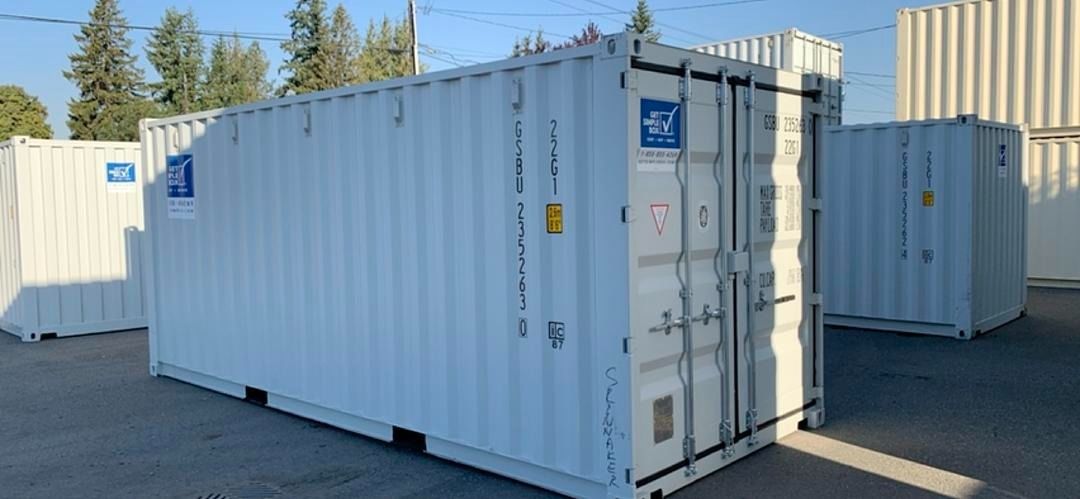
Four things: water standing on the roof, ground contact without drainage, condensation inside, and damage left untreated where the paint is broken.
- Standing water on the roof. Roof panels are the thinnest steel on the unit. A dent that holds a puddle after rain will perforate years before any other panel.
- Ground contact and poor drainage. A container set flat on soil keeps its bottom rail and floor bearers permanently damp. This is the most common cause of early failure we see in Europe.
- Condensation inside. Warm moist air meeting a cold steel roof drips onto the goods below and attacks the roof from the inside, where nobody looks.
- Untreated damage. Every scrape through the paint exposes bare steel. After one season it is cosmetic. After five years it is a hole.
Three of the four are settled at delivery, and cost nothing but planning. Our guide to preparing the site before delivery covers bearers, levels and fall.
What maintenance does a storage container need?
Very little, but it has to be regular. One inspection a year, a clear roof, working door seals and touched up paint cover most of it.
- Annual inspection, in autumn. Check the roof line, the corner castings and the bottom rail for rust blooming from underneath.
- Clear the roof two to four times a year. Leaves, needles and standing water are the same problem.
- Doors, every six months. Grease hinges and locking bars, check the rubber seals are soft, seated and unsplit.
- Touch up paint at least once a year. Wire brush, prime, paint. Twenty minutes buys years.
- Keep it off the ground and level. Pads or sleepers under the four corners, set with a slight fall so the roof drains.
Factory vents handle normal air exchange, but damp goods or a shaded site may call for desiccant or an extra vent.
Is a new one trip unit or a used container better value over 15 years?
Both will reach 15 years. A used unit costs far less at purchase, a one trip unit needs less repair and attention in the early years.
A one trip unit has made a single loaded voyage from the factory, so it is effectively new. Used units are graded: wind and watertight is the working standard for static storage, cargo worthy the grade needed to ship again.
| Over a 15 year horizon | New or one trip | Used, wind and watertight |
|---|---|---|
| Purchase price | Highest | Typically 40 to 50 percent less |
| Maintenance, years 1 to 5 | Inspection only | Inspection, paint, possible seal change |
| Maintenance, years 6 to 15 | Paint, seals | Paint, seals, possible roof or floor repair |
| Resale after 15 years | Stronger | Closer to scrap value |
On the 2026 European market a used 20 ft wind and watertight unit typically sells for 1,300 to 2,200 euros, and a new or one trip 20 ft unit usually for 2,800 to 4,200 euros. Figures vary by condition, location and transport distance, so treat these as market ranges rather than a quotation.
Over 15 years the gap is a few hundred euros a year. We suggest a one trip unit where the container is opened daily or will be modified, and a used unit where it only has to stay dry. See new versus used containers and what a shipping container costs in 2026 work through the trade off.
What are the signs a container is reaching the end?
Perforation in the roof, soft or rotten floor sections, rust through the bottom rail, and doors that no longer close square against the seals.
- Daylight visible through the roof or walls from inside with the doors shut.
- Floor boards that flex underfoot or delaminate at the edges.
- Doors that need forcing, or that leave a gap at one corner when closed.
Most of this is repairable: roof panels patched, floors replaced in sections, door gear rebuilt. The question is whether the repair costs less than the value left. When a unit needs a roof and a floor in the same year, replacement is usually better.
What else do people ask about container lifespan?
Short answers on surface rust, repainting intervals and whether an older container is still worth buying for storage today.
Does surface rust mean the container is failing?
No. Weathering steel is designed to carry a layer of oxide. What matters is whether the rust is flaking, pitting or perforating, especially on the bottom rail and roof.
How often should a container be repainted?
A full repaint every eight to ten years is usually enough inland, with local touch ups yearly. A coastal site with salt in the air needs a shorter cycle.
Is a 20 year old container still worth buying?
Often yes, for static storage. Grade and history tell you more than age, which is the real answer to how long do storage containers last.
Last updated: September 2026
Send us your requirement, size, condition and delivery location, and we will send a written quotation. Send us your requirement and get a written quotation.
How long do storage containers last also depends on paperwork, not just steel. Shipping use is governed by the International Convention for Safe Containers, which sets the periodic examination regime recorded on the CSC plate. A unit retired from shipping can still serve for years as static storage, provided the roof, the floor and the door seals are maintained.