
Legally, where can you put a shipping container? There is no single European answer, because planning law is written nationally and enforced locally. Here is how your own answer is decided, with real thresholds for France and Germany. We sell containers and we are not lawyers, so treat this as a guide to the questions to ask.
Where can you put a shipping container, and who decides?
Your municipality decides. Four things set the answer: what the container is used for, how big it is, how long it stays, and the local land use plan.
- Use. Storage, workshop, sleeping space and retail all differ.
- Size. Footprint in square metres or gross volume in cubic metres, by country.
- Duration. Weeks are rarely a problem, years usually are.
- Location. Zoning and the local plan outrank the general rule.
The local plan catches people out. A Bebauungsplan in Germany or a plan local d’urbanisme in France can be stricter, and can exclude containers from a residential zone even where the size threshold allows one.
Why does the intended use matter more than the container itself?
Planning law looks at what a structure is for, not how it is built. Storage, housing and workspace are judged differently on the same steel box.
Buyers assume a container is exempt because it arrives on a lorry and sits on blocks. Authorities ask what happens inside. The same 20ft unit can be a garden store needing a short declaration, or a habitable room needing a full permit. Container offices carry extra workplace rules.
What are the rules in France?
France works from footprint. Five square metres or less needs nothing, up to 20 needs a declaration, and above 20 needs a full building permit.
The official guidance from service-public.gouv.fr sets the bands:
- 5 m2 or less: no authorisation, unless attached to an existing building, which needs a déclaration préalable.
- More than 5 m2 up to 20 m2: déclaration préalable.
- More than 20 m2: permis de construire.
- Protected sectors: déclaration préalable up to 20 m2, permis de construire above that.
- Three months or less: no authorisation for a structure in place for that period.
So where can you put a shipping container in France with no paperwork? Only under 5 m2, or for three months or less. Your commune’s plan local d’urbanisme can still add conditions.
What are the thresholds in Germany?
Germany sets thresholds per federal state, most by gross volume in cubic metres and a few by floor area, so the same container can differ by state.
The comparison at containerbasis.de shows eleven states measuring gross volume and five gross floor area, and confirms that the intended use and the size decide, not the construction type.
- Bayern: 75 m3.
- Hamburg: 30 m3.
- Baden-Württemberg: 40 m3 inside built up areas, 20 m3 outside.
- Schleswig-Holstein: 30 m3 inside, 10 m3 outside.
A 10ft container fits within every state threshold. A 40ft needs permission in all sixteen states. A Bebauungsplan can override either way.
How do 10ft, 20ft and 40ft containers compare against these thresholds?
A 10ft unit stays under every German threshold. A 20ft sits in the middle and has to be checked. A 40ft needs permission nearly everywhere.
| Size | Footprint | Gross volume | France | Bayern, 75 m3 | Hamburg, 30 m3 |
|---|---|---|---|---|---|
| 10ft | about 7.3 m2 | about 19 m3 | Déclaration préalable | Under | Under |
| 20ft, 6.06 by 2.44 m | 14.8 m2 | about 38 m3 | Déclaration préalable | Under | Over |
| 40ft, 12.19 by 2.44 m | 29.7 m2 | about 77 m3 | Permis de construire | Over | Over |
These are our own worked figures from standard external dimensions. Treat them as an illustration, not a ruling: rules differ by country, by federal state and by municipality.
When is a container temporary rather than permanent?
Roughly three months is the common dividing line. In France a structure in place for three months or less needs no authorisation at all.
Many jurisdictions use a similar window, because a structure that comes and goes counts as an event rather than a building. The risk is drift: a unit placed for eight weeks and still there two years later is permanent.
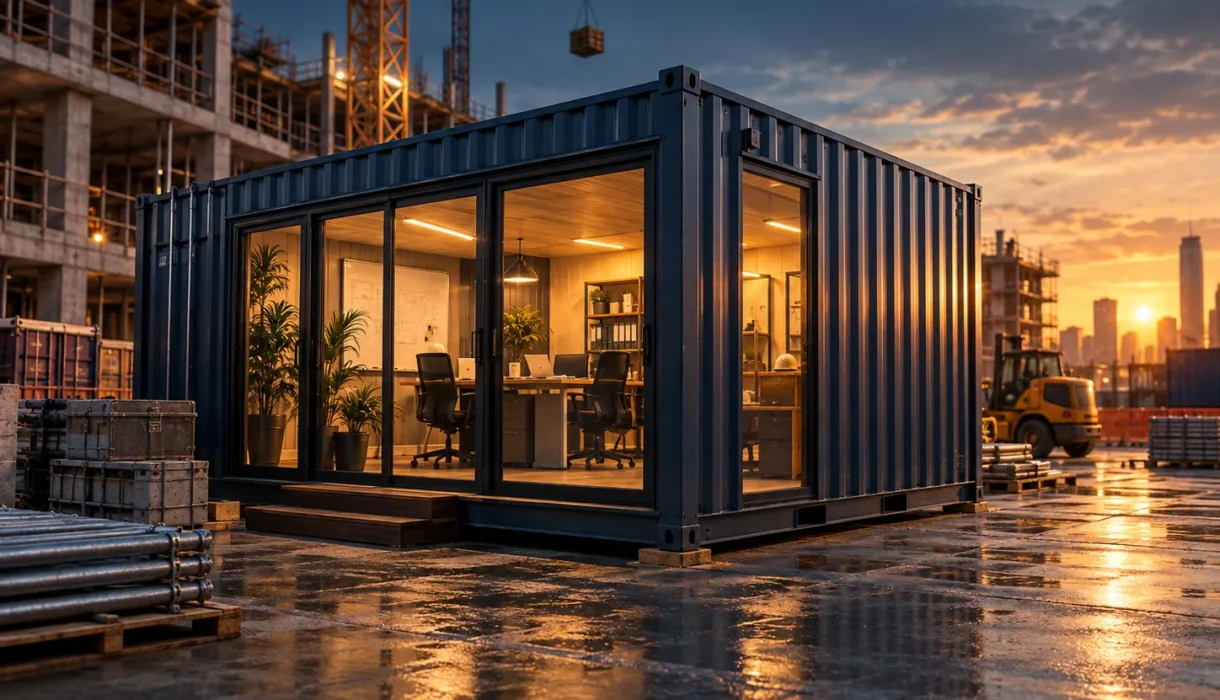
Construction site containers are treated separately. A site office serving approved works is covered by that project, though a container on a public road needs its own permission.
How close to the boundary can a container sit?
Most municipalities set a minimum distance to the boundary, often one to three metres. A neighbour’s written consent can sometimes shorten it.
Boundary rules apply even where the unit is too small to need a permit, usually for fire separation. In Germany the state code sets the distance and the Bebauungsplan can tighten it. Where neighbour consent counts, get it in writing.
Which sites are easy, and which are hard?
Commercial yards and farmland are usually easiest. Residential gardens are the hardest, because they carry the tightest rules on use and appearance.
On a commercial plot a storage container matches the zoning, so only size and siting are at issue. Farmland is similar where the use is genuinely agricultural. Gardens are harder: thresholds bite sooner, appearance rules stricter, neighbours closer. Anything kept for years should be built as permanent, including the foundation.
What happens if you install a container without consent?
The authority can order removal, charge a fine and refuse retrospective approval. The cost falls on the owner, not on the supplier.
Enforcement is complaint driven: nothing for months, then a notice, a deadline to apply or remove, and a fine. Approval after the fact is refused where the local plan bans the structure.
What should you ask your local authority before you buy?
Ask about the land use plan, the size threshold, any time limit, boundary distances and foundations. Get the answers in writing before ordering.
- Does the local plan allow a container of this use here?
- Which measure applies, footprint or gross volume, and what is the threshold?
- Is there a duration below which no consent is needed?
- What is the minimum distance to each boundary?
Settle where can you put a shipping container before you order. Our guide to preparing the site covers the groundwork.
What else do people ask about where you can put a shipping container?
Three short answers to the questions we are asked most often by buyers working out where a container may legally stand on their own land.
Does a container on wheels or skids avoid planning rules?
Rarely. Authorities look at whether the structure stays put and what it is used for, not how it might be moved.
Do I need permission for a container in my own garden?
Often yes. In France a footprint over 5 m2 triggers a déclaration préalable, which covers every standard container. In Germany it depends on the state and the Bebauungsplan.
Can a municipality refuse even when I am under the threshold?
Yes. A threshold exemption removes the permit requirement, not the local plan. If the plan excludes containers in that zone, that still applies.
Last updated: September 2026
Tell us the site and the intended use before you buy, and we will help match size and specification to what your authority accepts. See our new, used and modified containers.